White stone fireplaces have become the centerpiece of choice for homeowners looking to blend timeless elegance with modern design. Whether updating an existing hearth or planning a complete renovation, choosing white stone creates a bright, versatile focal point that works across multiple design styles. This guide walks through trending designs, material choices, and practical styling tips to help homeowners make informed decisions, from selecting between natural limestone and manufactured veneers to understanding installation considerations that might require professional help.
Table of Contents
ToggleKey Takeaways
- White stone fireplaces enhance natural light and create a sense of openness while hiding soot and ash better than dark materials, making them ideal for creating bright, versatile focal points in any home.
- Material choice significantly impacts cost and maintenance: natural marble and limestone offer luxury but require regular sealing, while quartzite provides durability, and manufactured stone veneer delivers cost savings starting at $8-$15 per square foot installed.
- Modern minimalist designs feature clean lines with linear gas inserts and floor-to-ceiling stone panels, while farmhouse styles balance whitewashed fieldstone or reclaimed brick with chunky wood mantels for authentic, relaxed elegance.
- White stone fireplace designs pair seamlessly with multiple styles—from Scandinavian minimalism to coastal aesthetics to traditional farmhouse—ensuring your fireplace won’t become outdated as design preferences change.
- Professional installation is essential for structural elements like large stone panels or heavy mantels to ensure proper support, correct safety clearances, and compliance with IRC fire-resistance requirements.
- Styling around white stone works best through contrast: dark metals and wood tones create definition, appropriately scaled artwork prevents visual clutter, and strategic lighting grazes the stone surface to emphasize texture and depth.
Why White Stone Fireplaces Are Trending Right Now
The shift toward white stone fireplaces reflects broader design trends favoring lighter, airier interiors that maximize natural light. Unlike dark brick or heavy wood mantels, white stone bounces light around the room, making spaces feel larger and more open, a significant advantage in homes with limited square footage or north-facing windows.
White stone also offers unmatched versatility. It pairs equally well with Scandinavian minimalism, coastal aesthetics, modern farmhouse styles, and even traditional settings when balanced with the right furnishings. This adaptability means homeowners won’t need to rip out their fireplace if design preferences shift in five years.
From a practical standpoint, white stone hides soot and ash better than many assume. Light-colored limestone and painted brick show less discoloration over time compared to unfinished red brick, which absorbs smoke residue into its porous surface. Regular sealing (every 1-2 years for natural stone) maintains the fresh appearance.
The material’s durability is another factor driving adoption. Natural stone like limestone, marble, and quartzite withstands heat exposure without degrading, while quality manufactured stone veneers offer similar longevity at a lower price point. Both options meet IRC fire-resistance requirements when properly installed with appropriate clearances from combustible materials.
Modern Minimalist White Stone Fireplace Designs
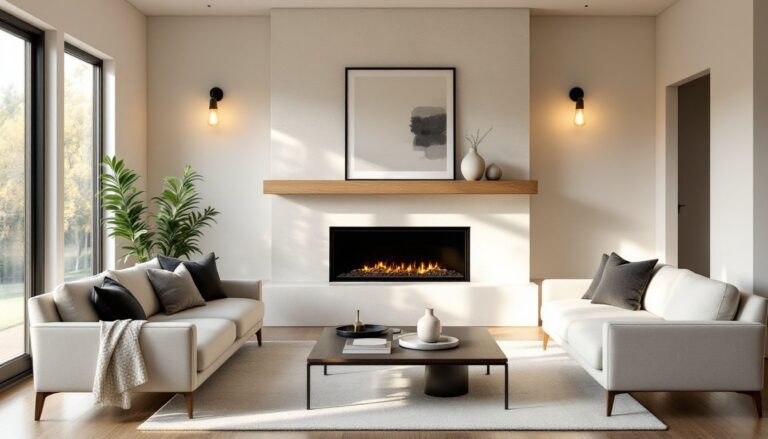
Modern minimalist fireplaces emphasize clean lines, flush installations, and restrained ornamentation. The stone itself becomes the statement rather than ornate mantels or decorative corbels.
Linear gas inserts paired with smooth white marble or honed limestone create the quintessential modern look. These units, typically 36″ to 60″ wide and only 12″ to 18″ tall, run horizontally rather than vertically, breaking from traditional fireplace proportions. Install them at floor level for a contemporary floating effect, or position at eye level (48″ to 60″ from the floor) when wall-mounted.
Floor-to-ceiling installations using large-format stone panels (often 24″ x 48″ or larger) eliminate grout lines and create a seamless appearance. This approach works particularly well with book-matched marble or quartzite, where adjacent slabs mirror each other’s veining pattern. Expect to hire professionals for this work, large stone panels require structural support, often needing blocking installed between wall studs during framing.
Monochromatic white-on-white schemes keep the entire fireplace wall in the same color family. Pair white Carrara marble with white oak floating shelves and white-painted drywall on surrounding walls. The subtle variations in texture and tone create depth without visual clutter. Many contemporary fireplace designs incorporate this approach for cohesive living spaces.
Skip the mantel entirely in ultra-minimal designs, or install a simple 2″ thick limestone slab cantilevered from the wall. This floating shelf approach maintains clean lines while providing a narrow display surface for a single piece of art or sculptural object.
Rustic Farmhouse White Stone Fireplace Inspiration
Farmhouse-style white stone fireplaces balance rustic texture with the lightness of whitewashed or painted finishes. The goal is relaxed elegance rather than formal polish.
Whitewashed fieldstone delivers authentic texture while keeping the overall palette light. This technique involves applying diluted white paint (typically 1 part paint to 3 parts water for latex products) over natural fieldstone, allowing the stone’s varied colors and irregular shapes to show through. The result reads as white from a distance but reveals character up close. Note that whitewashing is permanent on porous stone, test in an inconspicuous area first.
Reclaimed white brick offers another farmhouse-friendly option. Salvaged brick from demolished buildings provides authentic weathering and variation impossible to replicate with new materials. Expect to pay $4-$8 per square foot for reclaimed brick versus $1-$3 for new common brick (prices vary significantly by region). Installation costs run similar, $10-$20 per square foot for materials and labor in most markets.
Chunky wood mantels provide essential contrast against white stone. A rough-sawn oak or pine beam (6″ x 8″ or larger) mounted 54″ to 60″ from the hearth creates the substantial presence farmhouse design demands. Secure mantels to wall studs using lag bolts, never trust picture hangers or drywall anchors for weight-bearing elements. The International Residential Code requires 6″ minimum clearance between wood mantels and fireplace openings: extend this to 12″ for protruding mantels deeper than 1.5″.
Many cozy fireplace aesthetics layer shiplap or beadboard on the wall surrounding the stone, painted in warm whites or soft grays. This adds architectural interest without overwhelming the space. Install a solid wood mantel using metal brackets hidden underneath, or for lighter-duty applications, use decorative iron brackets as both structural support and design elements.
Choosing the Right White Stone Material for Your Fireplace
Material selection impacts appearance, maintenance requirements, installation complexity, and budget. Understanding the trade-offs helps homeowners make appropriate choices for their specific situation.
Marble offers the most luxurious appearance with distinctive veining in varieties like Carrara, Calacatta, and Statuario. Carrara, the most affordable option at $40-$100 per square foot installed, features soft gray veining on white backgrounds. Calacatta and Statuario command premium prices ($100-$250+ per square foot) with bolder, more dramatic veining. All marble is relatively soft (3-5 on the Mohs hardness scale) and porous, requiring sealing every 12-18 months. Acidic substances like wine or lemon juice will etch the surface, wipe spills immediately.
Limestone provides a softer, more uniform appearance without pronounced veining. Its matte finish and subtle texture work well in both traditional and contemporary settings. Expect $30-$75 per square foot installed. Like marble, limestone requires regular sealing but tolerates heat well. Its neutral tone complements wood accents naturally.
Quartzite delivers marble’s elegance with superior durability. This metamorphic stone rates 7 on the Mohs scale, harder than granite, and resists staining better than marble or limestone. The trade-off is cost: $70-$150+ per square foot installed. White quartzite often features subtle gray or gold veining. It’s the best natural stone choice for high-traffic households with kids and pets.
Soapstone offers a completely different aesthetic with its smooth, almost chalky appearance. While typically found in darker grays, some varieties feature lighter tones. Its exceptional heat resistance makes it ideal for fireplaces. Soapstone requires no sealing, it’s naturally non-porous, but develops a patina over time that many consider desirable.
Natural Stone vs. Manufactured Stone Options
Manufactured stone veneer delivers significant cost savings while mimicking natural stone’s appearance. Quality products have improved dramatically, many are indistinguishable from natural stone at typical viewing distances.
Manufactured veneer consists of Portland cement, aggregates, and iron oxide pigments cast in molds taken from real stone. Panels typically weigh 8-12 lbs per square foot versus 15-25+ lbs for natural stone, reducing structural demands. Installation costs run $8-$15 per square foot (materials and labor) compared to $25-$75+ for natural stone. Brands like Cultured Stone and Eldorado Stone offer white limestone and fieldstone profiles specifically for fireplace applications.
The durability question matters: quality manufactured stone lasts 50+ years when properly installed with appropriate weather barriers and drainage (for exterior applications). Interior installations face fewer stressors. Color is integral to the material rather than applied as surface coating, so chips don’t reveal a different color underneath.
Porcelain tile designed to mimic marble or limestone provides another alternative. Large-format tiles (12″ x 24″ or 24″ x 24″) minimize grout lines. Porcelain’s non-porous surface requires no sealing and cleans easily with standard household cleaners. Installation costs run $12-$25 per square foot. The material’s uniform appearance lacks natural stone’s organic variation, an advantage for those preferring consistency, a drawback for those wanting unique character.
Permit requirements typically don’t differ between natural and manufactured materials, but any fireplace work involving gas lines, structural modifications, or new installations requires permits in most jurisdictions. Cosmetic refacing of an existing fireplace generally doesn’t, but check local building department requirements before starting work.
Design Tips for Styling Around Your White Stone Fireplace
A white stone fireplace provides a neutral backdrop that works with multiple styling approaches. The key is balancing the stone’s visual weight with surrounding elements.
Contrast prevents the space from reading as bland. Against white stone, dark metals (matte black fireplace screens, wrought iron tools, or steel floating shelves) create definition. Wood tones, whether light oak or dark walnut, add warmth. Layering different whites (cream upholstery, bright white trim, warm white walls) builds depth through subtle tonal variation.
Scale matters with mantels and artwork. A substantial fireplace demands appropriately sized decor. A single large-scale piece (30″ x 40″ minimum for standard fireplaces) works better than multiple small items that appear scattered. When hanging art above a fireplace, position the piece 4″ to 8″ above the mantel, not at standard 57″ eye level, which would push it too high. Several elegant white stone surrounds demonstrate this proportional relationship effectively.
Symmetry versus asymmetry depends on the overall design style. Traditional and transitional rooms benefit from symmetrical arrangements, matching sconces, paired candlesticks, or identical chairs flanking the fireplace. Modern and eclectic spaces allow asymmetrical styling, a tall plant on one side balanced by a stack of books and sculptural object on the other.
Seasonal flexibility is one of white stone’s advantages. The neutral backdrop transitions easily from winter evergreens to spring florals to summer coastal elements without clashing. Keep a core of year-round elements (the art, major furniture pieces) and swap smaller accessories seasonally.
Lighting enhances the stone’s texture. Install recessed lights or track lighting to graze the stone surface at an angle, emphasizing its texture and depth. Wall sconces mounted 12″ to 18″ from the fireplace edges at 60″ to 66″ from the floor provide ambient lighting while drawing attention to the entire fireplace wall.
Safety clearances still apply when decorating. Combustible materials (wood, fabric, paper) must maintain minimum distances from fireplace openings per IRC requirements. For wood-burning fireplaces, this typically means 6″ clearance for items flush to the wall, or 12″ for protruding elements. Gas fireplaces generate less heat but still require specified clearances, check the manufacturer’s installation manual.
Conclusion
White stone fireplaces offer lasting value through their versatility, durability, and ability to enhance natural light in living spaces. Whether choosing the luxury of Carrara marble or the practicality of manufactured veneer, the material selection should align with budget, maintenance tolerance, and design goals. Proper installation, particularly for structural elements like heavy stone panels or mantel mounting, often justifies hiring professionals even though the added cost. The result is a focal point that adapts across changing design trends while providing decades of reliable performance.